Impact Test (Charpy/Izod)
Material testing plays a crucial role in the engineering and manufacturing industries to ensure the quality, reliability, and safety of materials used in various applications. Among different testing methods, Impact Testing is essential to determine a material’s ability to withstand sudden shocks or loads. Two of the most widely used impact testing methods are the Charpy Impact Test and the Izod Impact Test. These tests help engineers and manufacturers understand the toughness of a material, which is critical for products that face dynamic or impact loads during service.
What is an Impact Test?
The Impact Test measures the energy absorbed by a material when it is struck by a sudden force or load. It helps to assess the material’s toughness—its ability to resist fracture under rapid loading conditions. Unlike static tests such as tensile or compression tests, impact tests simulate real-world situations where materials may experience sudden forces, such as collisions or accidental drops.
Toughness is especially important in industries like automotive, aerospace, construction, and energy, where components often experience unexpected stresses. A material with high toughness will absorb more energy before breaking, while brittle materials will fracture quickly under impact.
Charpy Impact Test
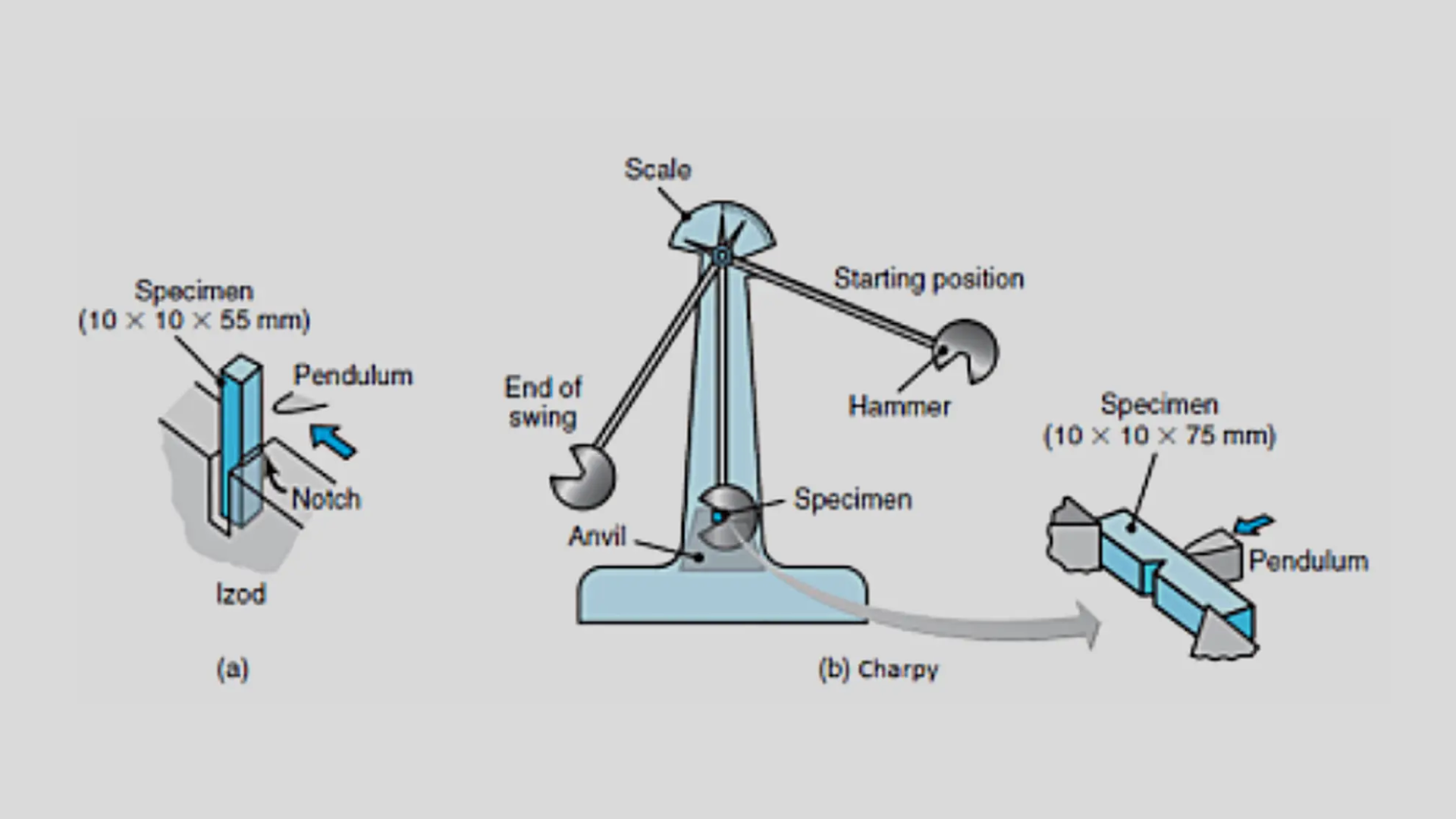
The Charpy Impact Test is one of the most common methods for evaluating material toughness. In this test, a notched specimen is placed horizontally on two supports. A pendulum hammer is then released from a fixed height to strike the center of the specimen. The energy absorbed by the specimen during fracture is measured and recorded.
Key points of the Charpy test include:
-
Specimen Position: Horizontal with the notch facing away from the hammer.
-
Specimen Size: Standard size is typically 10 mm × 10 mm × 55 mm.
-
Result Measurement: The difference in the hammer’s height before and after the strike indicates the energy absorbed.
The Charpy test is widely used for testing metals, polymers, and composites, particularly to evaluate their behavior at different temperatures.
Izod Impact Test
The Izod Impact Test is similar in purpose but differs in its specimen positioning and testing procedure. In this test, the specimen is clamped vertically as a cantilever beam, with the notch facing the striking hammer. The pendulum hammer hits the upper part of the specimen, and the energy absorbed during fracture is recorded.
Key points of the Izod test include:
-
Specimen Position: Vertical with the notch facing the hammer.
-
Specimen Size: Usually 10 mm × 10 mm × 75 mm.
-
Result Measurement: Energy absorbed is calculated similarly to the Charpy test.
Izod testing is often used for plastics and polymers, although it can also be applied to metals.
Importance of Impact Testing
Impact testing is vital for ensuring the durability and safety of materials in real-world applications. Some key benefits include:
-
Quality Control: Ensures that materials meet industry standards.
-
Material Selection: Helps engineers choose suitable materials for specific environments and stress conditions.
-
Safety Assurance: Identifies materials prone to brittle failure, especially in cold environments.
-
Performance Evaluation: Assesses how materials behave under sudden impacts.
Both the Charpy and Izod Impact Tests are indispensable tools in material testing. While they share the same goal of measuring toughness, their different testing methods provide insights for various types of materials and applications. By understanding how materials respond to sudden forces, engineers and manufacturers can design safer, more reliable products that perform well under real-life conditions.
Share This Wings
Related Post
Material Testing Lab
Biomedical Lab
Food Testing Lab
Education & R&D Lab
Metrology Lab
Calibration Lab

IT & Cyber-Security Lab

Simulation Lab

Port Management

Traffic Management

Border Management

Security Surveillance

Smart Lighting & Lightning
Tensile Strength Test

Hardness Test
Impact Test (Charpy/Izod)
Compression Test

Healthcare Laboratory
Medical Device Calibration
Quality & Safety Testing

Research & Development Support

Proximate Analysis

Microbiological Testing
Nutritional Labeling & Fortification

Safety & Compliance Testing

Chemistry Lab
Physics Lab
Biology Lab

Environmental Science Lab

Laboratory Accreditation

Quality Assurance Consultancy
Topics